HOOK-LIFT GARBAGE TRUCK VS. ROLL-OFF GARBAGE TRUCK
Efficient waste management systems are essential for maintaining clean, sanitary, and sustainable urban environments. Among the crucial vehicles in this industry are hook-lift garbage trucks and roll-off garbage trucks. While both play a vital role in waste transportation, they operate using different mechanisms and are designed for distinct applications.
What is a Hook-Lift Garbage Truck
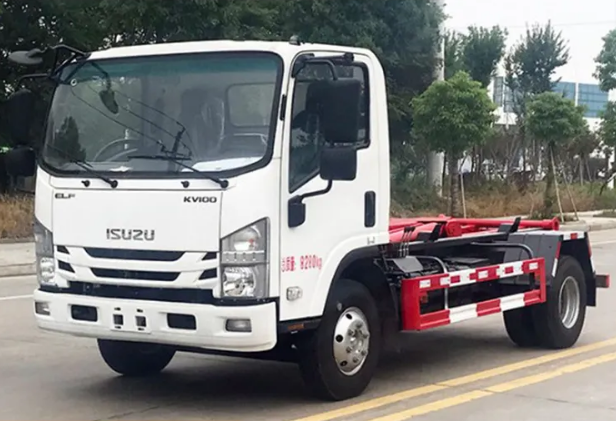
A hook-lift garbage truck is a highly versatile vehicle equipped with a hydraulic hook-loading system that enables it to lift, transport, and swap out containers of various sizes and shapes. This flexibility makes it ideal for operations requiring frequent container changes, enhancing efficiency in waste collection and transportation.
What is a Roll-Off Garbage Truck
A roll-off garbage truck is designed to haul large waste containers, commonly known as dumpsters. It utilizes a hydraulic lift system to roll containers on and off the truck bed, making it well-suited for construction sites, commercial facilities, and other locations that generate substantial waste volumes.
In-Depth Analysis of Hook-Lift Garbage Trucks
Operational Mechanism
Hook-lift garbage trucks utilize a hydraulic arm equipped with a hook to latch onto a container’s designated fixture. The system then lifts and smoothly slides the container onto the truck bed, allowing for efficient loading and unloading.
Common Applications
These trucks are widely used in residential and commercial waste collection, recycling operations, and environments where space constraints demand precise maneuverability.
Advantages of Hook-Lift Garbage Trucks
- High precision in container handling
- Compatibility with various container sizes
- Ideal for confined or space-restricted areas
Disadvantages of Hook-Lift Garbage Trucks
- Generally lower load capacity compared to roll-off trucks
- Slower operation due to the need for precise container placement
In-Depth Analysis of Roll-Off Garbage Trucks
Operational Mechanism
Roll-off garbage trucks use a winch and cable system to pull containers onto the truck bed, which tilts at an angle to facilitate loading and unloading. This mechanism allows for efficient handling of large waste containers.
Common Applications
These trucks are commonly used at construction sites, demolition projects, and large-scale waste disposal operations where substantial amounts of debris need to be transported.
Advantages of Roll-Off Garbage Trucks
- Higher capacity for handling large waste volumes
- Simple yet robust mechanism capable of carrying heavier loads
Disadvantages of Roll-Off Garbage Trucks
- Less precision in container placement compared to hook-lift trucks
- Requires more space for loading and unloading operations
Key Differences Between Hook-Lift and Roll-Off Garbage Trucks
Mechanism and Operation
Hook-lift trucks use a hydraulic hook system to lift and position containers, while roll-off trucks rely on a winch-and-cable or hydraulic rolling mechanism. This distinction affects their efficiency and suitability for different operational environments.
Flexibility and Versatility
Hook-lift trucks offer greater flexibility, accommodating various container types and sizes. In contrast, roll-off trucks are optimized for transporting large volumes of waste but are restricted to specific container dimensions.
Cost and Maintenance
Due to their advanced hydraulic systems, hook-lift trucks typically have higher initial costs and require specialized maintenance. Roll-off trucks, with their simpler design, often come with lower upfront costs and easier maintenance.
Efficiency and Speed
Hook-lift trucks are ideal for operations requiring frequent container swaps, ensuring quick and seamless transitions. Roll-off trucks, while highly effective for transporting large waste loads, may be slower in scenarios requiring multiple container exchanges.
Applications and Suitability
Hook-lift trucks are well-suited for municipal waste collection, recycling operations, and industries needing frequent container changes. Roll-off trucks excel in construction sites, large-scale commercial waste management, and applications involving heavy or bulky materials.
Practical Considerations for Choosing Between Hook-Lift and Roll-Off Trucks
- Operational Environment: Hook-lift trucks are ideal for urban areas with limited space, while roll-off trucks are better suited for open, high-volume sites like construction zones.
- Type of Waste: Hook-lift trucks offer versatility for handling different waste types, whereas roll-off trucks are more effective for transporting heavy and bulky materials.
- Budget: Consider both the initial investment and long-term maintenance costs. While hook-lift trucks typically have higher upfront costs, they provide greater operational flexibility.
- Frequency of Container Changes: For operations requiring frequent container swaps, hook-lift trucks offer a significant efficiency advantage over roll-off trucks.


评论
发表评论